
Fans photograph a creator at a public event — inside the creator economy
Remove the Creators, and All Media Platforms Go Dark
A Theodyx Report on the Creator Economy, the Payment Crisis, and the Coming Age of Verified Human Creativity
The Platform Problem
Open the platform selector inside Theodyx scouting and you will find a dropdown of 37 destinations. Instagram, TikTok, YouTube. Douyin in China. VK in Russia. ShareChat in India. LINE in Japan. Naver in Korea. Different markets. Different algorithms. Different rules, currencies, and cultural grammars. Thirty-seven ways to reach a human being.
Now run the thought experiment that reorganizes everything. Remove the platforms, and creators keep creating — on the street, on paper, on a stage, in a group chat. Remove the creators, and all platforms go dark. Not dimmed. Dark. An algorithm with nothing to rank. A feed with nothing to serve. An ad auction with no attention to sell.
This is the asymmetry the entire industry is built to obscure. The platforms are distribution. The creators are the value. Everything Theodyx builds proceeds from that single inversion.
We are a media and technology firm that operates, builds, and owns ventures alongside the creators, brands, and institutions shaping the next era of media. Our purpose is to turn influence into enduring enterprise value. Representation, strategy, rights, finance, and growth connected into one operating system.
This report explains why that system is not a luxury. It is the missing infrastructure of a half-trillion-dollar economy.
Platforms Are Distribution. Creators Are the Value.
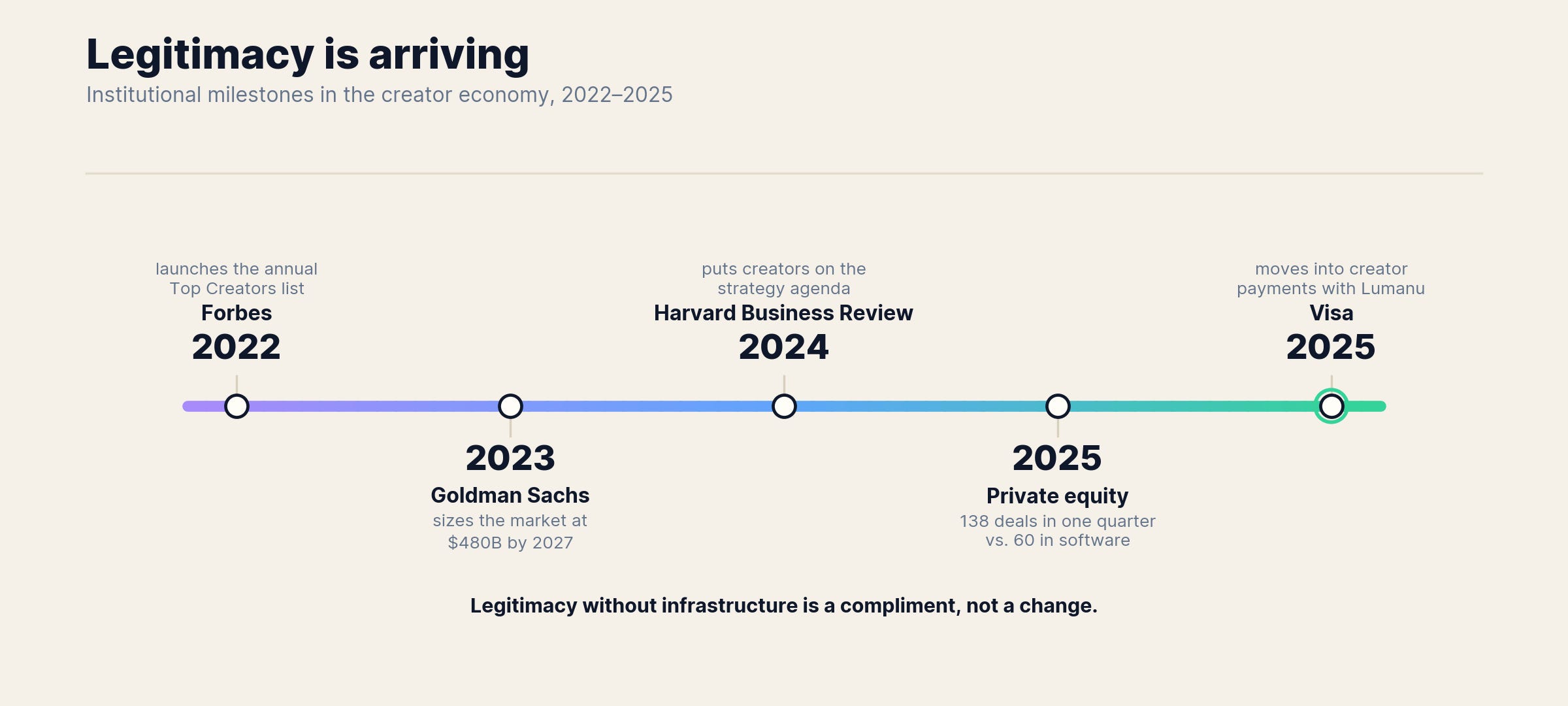
Let’s start with the size of the thing. Goldman Sachs Research projected in 2023 that the creator economy’s total addressable market could roughly double from $250 billion to $480 billion by 2027.1 That is not a fringe estimate. It has become the consensus anchor cited by Forbes, Business Insider, and the trade press for three years running.2
Newer market models run even hotter. The Business Research Company put the market at $255.66 billion in 2025 and forecasts $820.83 billion by 2030 at a 26.2% compound annual growth rate.3 eMarketer estimates that US influencer marketing spending rose 23.7% in 2024 and surpassed $10 billion in 2025 — reaching $10.52 billion, up 15.0% year over year — with 15.7% growth forecast for 2026 and US sponsored-content spend on track to hit $13.7 billion by 2027.4 Whichever curve you trust, the direction is identical: up and to the right, faster than the ad market it is quietly eating.
And who are the people underneath the number? Goldman Sachs counts roughly 50 million global creators.5 SignalFire’s Creator Economy Market Map breaks that population down with uncomfortable clarity: only about 2 million-plus are “professional” full-time creators, while roughly 46.7 million are part-time “amateur” creators.6 The U.S. Chamber of Commerce cites the same split.7
Here is where the story turns. This is a huge economy that pays almost no one well.
Goldman Sachs found only about 4% of global creators qualify as professionals earning more than $100,000 a year. A share the bank expects to stay roughly constant even as the ecosystem doubles.8 Linktree’s survey of more than 9,500 creators found only 12% of full-time creators earn over $50,000 a year, and 46% of full-time creators make less than $1,000.9 Gigapay’s 2026 Creator Pay Report puts the median creator’s annual income near $3,000, with 48.7% earning under $10,000, while the top 10% of creators capture 62% of all brand payments.10

This is a winner-take-most economy wearing the costume of a democratized one. Brand deals dominate creator revenue — Goldman Sachs put them at roughly 70% of the total.11 That single dependency means most creators live one algorithm change and one delayed invoice away from the end of their business.
The academy has been saying this for a decade. Cornell’s Brooke Erin Duffy, who introduced the concept of “aspirational labor” and later expanded it in her book (Not) Getting Paid to Do What You Love, documents how creative workers are urged to do what they love in exchange for exposure that rarely converts to income.12 Her later peer-reviewed work names the deeper condition: “algorithmic precarity,” in which anticipating opaque platform systems becomes a permanent part of the job.13 A 2025 scoping review in the Journal of Medical Internet Research found documented burnout among content creators across multiple studies.14 Industry data quantifies it: a Billion Dollar Boy study conducted by Censuswide in July 2025 — surveying 1,000 creators and 1,000 senior marketers across the US and UK — found that 52% of creators have experienced burnout as a direct result of their career, leading nearly two in five (37%) to actively consider leaving the profession altogether. Financial instability ranked as the No. 1 severity factor (55%), and 59% said burnout negatively impacts their careers.15
So, legitimacy is arriving, but not yet stability. The capital has noticed. Digiday, drawing on WY Partners’ Media & Technology M&A review, reported that private equity firms and venture capitalists struck 138 deals in the reviewed quarter, versus 60 by software companies.16 Summit Partners backed a $250 million deal for Later’s acquisition of Mavely; PSG invested $150 million in Uscreen.17 The creator economy is being institutionalized around the creators. The question Theodyx asks is whether the creators themselves get institutionalized with it — as rights-holding enterprises — or get left as line items on someone else’s balance sheet.
Legitimacy without infrastructure is a compliment, not a change.
An Economy This Size Shouldn’t Run on Email and Net-120
Walk into the back office of the creator economy and the half-trillion-dollar number dissolves into a mess of PDFs, spreadsheets, and unanswered follow-up emails.
Campaign US ran the definitive investigation in 2025. Its Creator Pay Report found that up to 87% of surveyed creators have been paid late or experienced payment issues, drawing on data from payment platforms including Tipalti and Lumanu.18 Creators routinely wait 60 to 180 days for money they have already earned. The report traced the cause to outdated enterprise payment systems, layered approvals, and “pay when paid” policies that push financial risk down the chain onto the person with the least cushion to absorb it.19 The finding was significant enough that when Visa and Lumanu announced a partnership to speed creator payments in December 2025, they cited it directly.20
That number is not an outlier. It is corroborated up and down the industry. A finding mirrored by Tipalti’s own survey reported via Digiday, which found 56% of creators had faced late payments and 74% had stopped working with a brand after feeling undervalued.21 Gigapay’s 2026 report confirms payment delays still reach 120 days.22 Deloitte’s Digital Platform Economy Payments analysis, cited in industry coverage, notes that payment terms for major brand partnerships can stretch to 120 days.23

Then there is the dashboard problem. A creator operating across all 37 platforms is reconciling 37 analytics views, 37 payout schedules, 37 sets of terms — none of which communicate with one another. The brand on the other side sees the same fog from the opposite direction: fragmented performance data, unverifiable delivery, contracts whose status is a mystery until someone forwards an email thread.
This opacity is not an accident. It is a business model. Intermediaries who hold funds for 90 to 120 days earn float on money that belongs to the creator. Agencies that control the only copy of a performance dashboard control the relationship. The friction of onboarding and paying a hundred small creators is exactly what pushes budgets toward a handful of large ones. Meaning the payment problem and the inequality problem are the same problem.24
In this industry, opacity has always been someone’s business model.
Transparency is ours.
That is why Theodyx treats settlement as infrastructure, not afterthought. Authenticated agreements, clear performance, and accountable outcomes, from first signal to final settlement. Each time. Clear terms, visible status, accountable timelines. The creator economy does not need another dashboard. It needs a system of record.
The AI Flood Makes Verified Human Creativity the Scarce Asset
For most of the internet’s history, the scarce thing was reach. Now reach is infinite and cheap, and the scarce thing is proof that a human made something.
Consider the flood. Ahrefs analyzed 900,000 newly created web pages in April 2025 and found that 74.2% contained AI-generated content; only about 2.5% were “pure” AI with no human editing.25 Graphite’s landmark study, updated and republished in May 2026 as “AI Now Writes as Many Online Articles as Humans,” found that the share of newly published articles that are primarily AI-generated now sits at roughly 50%, statistically even with human-written work.26 Within 12 months of ChatGPT’s November 2022 launch, that share jumped to 36%; it reached 48% by 24 months, then plateaued near 50% from Q1 2025 onward. AI briefly surpassed humans at 50.9% in Q4 2025 before settling back to 49.9% in Q1 2026.27
Graphite’s methodology matters, because credibility is the whole point. The new study averages three independent AI detectors — Pangram, GPTZero, and Copyleaks — with false positive and false negative rates each held below 2%, across 55,400 Common Crawl articles.28 Graphite’s own hypothesis for the plateau is telling: primarily-AI articles perform poorly in search, so the incentive to mass-produce them is self-limiting.29 Indeed, Graphite found that 86% of articles ranking in Google Search, and 82% of articles cited by ChatGPT and Perplexity, were still human-written.30

Source: Graphite, "AI Now Writes as Many Online Articles as Humans," May 2026 — average of Pangram, GPTZero & Copyleaks across 55.4K articles
The web is also increasingly not even human on the traffic side. Imperva’s 2025 Bad Bot Report found that for the first time in a decade, automated traffic surpassed human activity, accounting for 51% of all web traffic; bad bots alone made up 37%.31 Imperva’s 2026 follow-up pushed automated traffic to 53%, with human activity down to 47% and still falling.32

Now layer on the fraud. Sumsub’s 2025–2026 Identity Fraud Report, built on more than 4 million analyzed fraud attempts, documented a “sophistication shift”: multi-step fraud grew 180% year over year.33 Sumsub’s Q1 2025 data showed deepfake fraud surging 1,100% in the United States and synthetic identity document fraud rising more than 300%.34 The UK government projected 8 million deepfakes shared in 2025, up from 500,000 in 2023.35 The old, widely cited Europol projection that up to 90% of online content could be synthetically generated by 2026 came from the Europol Innovation Lab’s 2022 report Facing Reality? Law enforcement and the challenge of deepfakes. A document now accessible directly through Europol’s own servers.36
Here is what all of this does to value. When anyone can generate anything, the market re-prices authenticity. Raptive’s survey of 3,000 U.S. adults found that trust in content dropped nearly 50% when readers suspected it was AI-generated, even when it was actually human-written, and that 52% of consumers disengage from suspected AI content entirely.37 Purchase consideration and willingness to pay a premium each fell 14%.38 Pew Research Center found that 76% of Americans think it is extremely or very important to know whether what they are seeing was made by AI or by a human, yet only 12% are highly confident they could tell the difference.39 The Edelman Trust Barometer’s 2025 flash poll on AI found trust in AI at an inflection point, with acceptance tightly bound to trust: just 32% of Americans said they trust AI, versus 72% in China.40

The cruel irony, documented by MIT, is that the AI content is often good. The MIT Sloan study by Yunhao Zhang and Renée Richardson Gosline, “Human Favoritism, Not AI Aversion,” which used professional creators from Accenture Research for its human-written copy, found that when people did not know the source, they preferred AI-generated persuasive content; but when told a human was involved, their estimation rose.41 People do not dislike AI writing. They value human authorship. That is the entire market signal.
So, the question that will define the next decade of media is not “is this good?”
It’s who actually made this, and can they prove it?
The Missing Layer
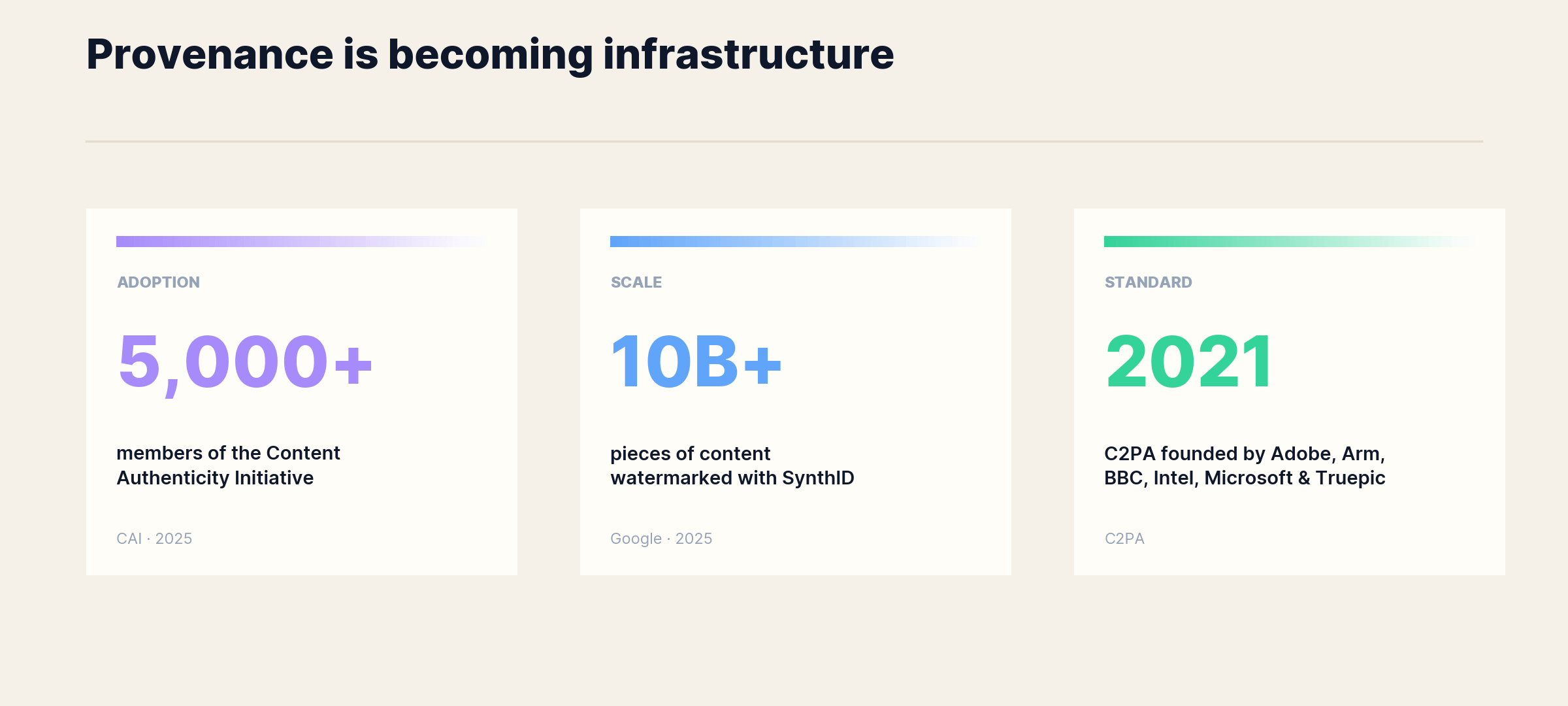
Every serious institution now agrees that provenance, a verifiable record of who made a piece of content and how, is becoming basic infrastructure rather than merely a nice-to-have. The standard has a name: C2PA, the Coalition for Content Provenance and Authenticity, formed in 2021 by Adobe, Arm, BBC, Intel, Microsoft, and Truepic to unify the Content Authenticity Initiative and Project Origin.42 Its Content Credentials attach a cryptographically signed, tamper-evident manifest to a file, recording its origin and edit history.43
The adoption curve is steep. Adobe’s Content Authenticity Initiative announced it had passed 5,000 members in 2025.44 The U.S. government’s cybersecurity agency, CISA, endorsed Content Credentials in a January 2025 advisory titled “Strengthening Multimedia Integrity in the Generative AI Era.”45 Cameras from Leica, Sony, and Nikon now sign at capture, and the Samsung Galaxy S25 attaches Content Credentials to AI-edited images; Cloudflare, which fronts a large share of internet traffic, became the first major CDN to support Content Credentials.46 On the watermarking side, Google reported at its 2025 developer conference that SynthID had been used to watermark more than 10 billion pieces of content.47
Sources: Content Authenticity Initiative 2025 · Google I/O 2025 · C2PA.org
Provenance is not a cure-all — the RAND Corporation warned in June 2025 that C2PA’s success depends on end-to-end compliance that an open ecosystem cannot guarantee, and that metadata is easily stripped by a screenshot.48 But the direction is unmistakable and, for Theodyx, deeply affirming. The entire industry is converging on the principle that has been our thesis from the beginning: the work must carry proof of who made it.
This is the missing layer, and Theodyx is building it along three connected lines.
First, we change how our clients and partners are viewed. Some of them are content creators; others are brands and institutions. All of them are treated by the current system as campaign line items. Attention to be rented by the impression. We view them as what they actually are: rights-holding enterprises with durable, ownable value. Harvard Business School’s Rebecca Karp has documented how creators are rewriting the innovation and strategy playbook for established companies, driving demand, accelerating product cycles, and changing what customers value.49 These are not vendors. They are engines. The representation, strategy, and rights work Theodyx does exists to make that status real and bankable.
Second, we modernize dashboards and payments. One authenticated view instead of 37. Settlement with clear terms, visible status, and accountable timelines. In a market where up to 87% of creators report late payments or payment issues and 74% have walked away from a brand after feeling undervalued, on-time, transparent settlement is not a feature, it is the whole relationship.50 Harvard Business Review’s December 2025 analysis by Barbara Duffek (Georgia State) with Andreas B. Eisingerich and Omar Merlo (Imperial College Business School) found that influencer marketing is now a $24 billion industry, yet trust is eroding precisely because transparency and integrity have been treated as optional: while 88% of consumers say authenticity matters, nearly half believe most influencers are fake, and over a third think influencers misrepresent themselves and the products they endorse.51 Transparency is the product.
Third, and most importantly, transparency is our operating principle. From first signal to final settlement, we bring visibility to every stage of a partnership: authenticated agreements, clear performance, accountable outcomes. Provenance for the work. Verification for the commerce. A system of record for a relationship that has never had one. As the world standardizes on Content Credentials and watermarking to answer “who made this,” Theodyx answers the adjacent question the standards bodies do not touch: who got paid for it, on what terms, and can everyone see the truth of it?
The Constant
Strip away the platforms, the algorithms, the funding rounds, the models, and the fraud, and one thing remains standing: a person with something to say and the will to make it.
That is the constant. Platforms rise and fall — Vine is gone, and something you have never heard of will own attention in five years. Algorithms rewrite themselves quarterly. AI will keep getting better at imitating the surface of creativity. But the source, the specific, unrepeatable human act of expression, cannot be automated, only imitated. And a market that is drowning in imitation will pay, more and more, for the real thing it can verify.
This is why we are optimistic where others are anxious. The AI flood does not devalue human creativity. It makes it scarce, and that scarcity is the beginning of value. The trust crisis does not doom media. It clears the ground for whoever can prove they deserve trust. The payment mess is not permanent. It is a solvable engineering problem that no one had the incentive to solve until creators became enterprises worth building infrastructure for.
Theodyx is here to build that infrastructure and to stay. Not to rent creators to brands by the impression, but to turn influence into enduring enterprise value. To treat the people who make the work as the owners of it. The creators are the value. Everything else is distribution.
– Theodyx
Notes & sources
- Goldman Sachs Rsch., The Creator Economy Could Approach Half-a-Trillion Dollars by 2027 (Apr. 19, 2023), goldmansachs.com.
- How the Creator Economy Is Reshaping Modern Marketing — and Why Brands Are Paying Attention, Forbes (June 16, 2025), forbes.com.
- The Bus. Rsch. Co., Creator Economy Market Report 2026 (2026), researchandmarkets.com.
- Emarketer, US Influencer Marketing Spending Will Surpass $10 Billion in 2025 (Mar. 13, 2025), emarketer.com; Influencer Marketing Set to Surpass $13 Billion by 2027, EMARKETER, emarketer.com (last visited July 17, 2026).
- Goldman Sachs Rsch., supra note 1.
- SignalFire, SignalFire’s Creator Economy Market Map (2024), signalfire.com.
- U.S. Chamber of Com., What Is the Creator Economy, and How Does It Work?, uschamber.com (last visited July 16, 2026).
- Goldman Sachs Rsch., supra note 1.
- Only 12% of Full-Time Creators Make Over $50K a Year, Says Linktree, TechCrunch (Apr. 20, 2022), techcrunch.com.
- Gigapay, The 2026 Creator Pay Report (2026), gigapay.com.
- Goldman Sachs Rsch., supra note 1.
- Brooke Erin Duffy, The Romance of Work: Gender and Aspirational Labour in the Digital Culture Industries, 19 Int'l J. Cultural Stud. 441 (2016), journals.sagepub.com.
- Brooke Erin Duffy, Annika Pinch, Shruti Sannon & Megan Sawey, The Nested Precarities of Creative Labor on Social Media, 7 Soc. Media + Soc’y (2021), journals.sagepub.com.
- Pathological Processes Among Content Creators on Social Media: Scoping Review, 27 J. Med. Internet Rsch. (2025), pmc.ncbi.nlm.nih.gov.
- Billion Dollar Boy, Over Half of Creators Face Burnout (2025), billiondollarboy.com.
- In Graphic Detail: Inside the Creator Economy’s M&A Boom, Digiday (Aug. 5, 2025), digiday.com.
- Id.
- New Campaign Report Reveals Why Creators Still Aren’t Getting Paid on Time, Campaign US (Sept. 3, 2025), campaignlive.com.
- Id.
- Visa and Lumanu Ink Deal for Speedy Influencer Payments, Campaign US (Dec. 2025), campaignlive.com.
- In a Booming Influencer Economy, Creators Seek Standardization for Payment Terms, Digiday (Feb. 22, 2024), digiday.com.
- Gigapay, supra note 10.
- Gigapay: Payment Delays Hamper Influencer Marketing Growth, FinTech Mag. (2024), fintechmagazine.com.
- Gigapay, supra note 10; see also supra notes 18–19 and accompanying text (payment-delay data).
- Ahrefs, 74% of New Webpages Include AI Content (Study of 900K Pages) (2025), ahrefs.com.
- Graphite, AI Now Writes as Many Online Articles as Humans Do (May 13, 2026), graphite.io.
- Id.
- Id.
- Id.
- Graphite, AI Content in Search & LLMs (2025), graphite.io.
- Imperva, 2025 Bad Bot Report (2025), imperva.com.
- Imperva, Bad Bot Report 2026: Bots in the Agentic Age (2026), imperva.com.
- Sumsub, Identity Fraud Report 2025–2026 (2025), sumsub.com.
- Sumsub, Synthetic Identity Document Fraud Surges 300% in the U.S. (2025), sumsub.com.
- Sumsub, supra note 33.
- Europol Innovation Lab, Facing Reality? Law Enforcement and the Challenge of Deepfakes (2022), europol.europa.eu.
- Suspected AI Content Halves Reader Trust and Hurts Ad Performance, Adweek (2025), adweek.com.
- Id.
- Pew Rsch. Ctr., How Americans View AI and Its Impact on People and Society (Sept. 17, 2025), pewresearch.org.
- Edelman, 2025 Edelman Trust Barometer Flash Poll: Trust and Artificial Intelligence at a Crossroads (2025), edelman.com.
- MIT Sloan, Study Gauges How People Perceive AI-Created Content (2023), mitsloan.mit.edu.
- Coal. for Content Provenance & Authenticity, C2PA, https://c2pa.org/ (last visited July 16, 2026).
- Id.
- Content Authenticity Initiative, 5,000 Members: Building Momentum for a More Trustworthy Digital World (2025), contentauthenticity.org.
- Cybersec. & Infrastructure Sec. Agency & Nat’l Sec. Agency, Strengthening Multimedia Integrity in the Generative AI Era (Jan. 29, 2025), media.defense.gov.
- Content Authenticity Initiative, supra note 44.
- Google Says SynthID Has Been Used to Watermark Over 10 Billion Pieces of Content, TechCrunch (2025), techcrunch.com.
- RAND Corp., Overpromising on Digital Provenance and Security (June 2025), rand.org.
- How Your Business Should Tap into the Creator Economy, Harv. Bus. Rev. (May 2024), hbr.org.
- New Campaign Report, supra note 18; In a Booming Influencer Economy, supra note 21.
- Barbara Duffek, Andreas B. Eisingerich & Omar Merlo, How to Do Influencer Marketing That Customers Actually Trust, Harv. Bus. Rev. (Dec. 2025), hbr.org.
Published by Theodyx · Our Thinking
Express what only you can.
Any article provided on “Our Thinking” is for educational purposes only. The information contained in this article does not constitute a recommendation from any Theodyx entity to the recipient, and Theodyx is not providing any financial, economic, legal, investment, accounting, or tax advice through this article or to its recipient. Neither Theodyx nor any of its affiliates makes any representation or warranty, express or implied, as to the accuracy or completeness of the statements or any information contained in any article, and any liability therefor (including in respect of direct, indirect, or consequential loss or damage) is expressly disclaimed.